Wednesday, February 08, 2006

Recovery for Niger


Can you hear him now?

In Niger, periods of drought and food shortages unfortunately are not uncommon and often people will ascribe a period of hardship a name. In the village of Doundayé people are calling the 2004/05 crisis “Seloula” or “Cellular.” Goshi Naruwa, an elderly woman, explained that Seloula is an analogy to cell-phone coverage. She jokingly said, “Seloula: ta shafi kowa,” meaning that it covered (affected) everyone. Another variation on the theme was: “Seloula: ta soulali kowa,” it shriveled everyone (like a steamed vegetable). Although said in jest, sadly, the images of Niger shown to the world last year back up the truths behind these statements.

The images shown by the media led to a large-scale relief mission undertaken by the Government of Niger and the United Nation’s World Food Programme. By the end of the operation in mid-October, CARE--one of many NGOs implicated in the relief effort--had distributed over 20,000 tons to almost 2 million people in Niger.

The acute crisis is over, harvests are in and households once again have food to eat; yet, those left weakened by the crisis continue to feel its aftershocks. CARE distributed food at the height of the crisis and now is helping, post-crisis, communities recover and prepare for the future. In the Tahoua and Zinder regions, CARE, is working to rehabilitate moderately malnourished children under the age of five.

In places like Niger, where household food security is tenuous, caloric and nutrient intake waxes and wanes throughout the year. Children are particularly sensitive to these kinds of fluctuations and predictably move through stages of declining nutrition when adequate calories and/or nutrients are not available—from mild to moderate malnutrition and eventually severe malnutrition. Once severely malnourished, a child risks suffering permanent developmental retardation, and ultimately death. Thankfully, if detected and treated early enough, almost all children can regain the weight and health from periods of malnutrition.

Doundayé, a medium-sized village an hour’s drive west of Konni, is participating in the nutritional rehabilitation project. An initial nutritional screening of the village’s 450 households identified 116 moderately malnourished children under the age of five. These children became the project’s first cohort. Under the project design, mothers of this cohort will receive a monthly ration of food—comprised of millet, cowpeas, and oil—with which to prepare three daily meals for their malnourished child (or children). To ensure that the child receives the full portion, the family also receives an accompanying food ration to supplement the household’s food supply. At the end of every month, the children are re-examined and their progress evaluated (i.e., weight gain or loss and increased or decreased brachial radial measurements). If a child receives two successive “healthy” assessments from the exams, he graduates from the program.


Doundayé's Exemplary Mothers

The project’s success hinges upon the identification and involvement of local Exemplary Mothers (mamans lumières). Who and what are Exemplary Mothers? At the same time that CARE agents identified the cohort of malnourished children, they also identified children that were especially hale and hearty. The mothers of these children were recognized as being “exemplary” in the way they cared for their children and managed their households. As such, they and were recruited to take an active role in the nutritional rehabilitation project. Each Exemplary Mother (EM) is responsible for teaching a group of 15 cohort mothers how to properly prepare the feeding recipes, which have been specially formulated to deliver the appropriate quantity of calories and grams of carbohydrates, proteins, and fats to the malnourished child.

Through this these interactions, it is hoped that an EM will not only transfer the knowledge of how to prepare recipes, but also will assist in behavior modifications that result in better hygiene and an overall improvement in health status. The changes are small, but crucial, such as using clean water to prepare food and keeping children and living areas clean. Amazingly, an EM receives no payment for her involvement in the project, apart from the use of empty oil containers, which they use to carry and store water.

In Doundayé, CARE has identified about a dozen women who meet the requirements to be chosen as Exemplary Mothers. The interesting thing about these women—as well as the women who have malnourished children—is they are a diverse group that resists classification. They are diverse with regard to ethnicity, age and economic standing.


16 years old, mother of one, already an EM

However, in speaking to women from both groups, and by visiting them in their homes, some telling similarities among the groups begin to emerge. Nana, mother to malnourished Ibro, aged 2, embodies many of the traits found across other mothers in her group. Appearance wise, both she and her child are clothed in dirty outfits and flies cover Ibro’s mouth, nose and eyes. Shy and demure, she avoids eye contact and expresses her ideas and thoughts with difficulty. When asked how Ibro became malnourished, Nana recalls that three months ago Ibro suffered from a fever, diarrhea, and was vomiting. She admits that initially she hesitated to take her sick child to the health center, three kilometers away, for treatment. Eventually, she took Ibro there for treatment and in the end she had to make three trips to the health center to buy medicine and receive consultations. The episode left Ibro weak and earned him a spot in the nutritional recovery program. Already, his health is improved, but he is still not totally recovered to his pre-illness health, and he will likely re-enroll in the program after the next monthly examination.

In stark contrast to this portrait, at the other end of the spectrum is Kuluwa, an EM with 5 children, the youngest being 22 months. She has a confident air about her and there is a peacefulness that radiates from her well-kempt home. She can explain 4 ways of being a good mother in Niger. First, she makes sure that her children eat well and that the food itself is high quality. Next, when her kids do get sick, she prevents the sickness from becoming too serious by visiting the nearest health center, 3 kilometers away. Third, Kuluwa stresses that washing and cleanliness are very important. She says sincerely, “You just don’t feel well if you are dirty or are wearing something that is dirty.” And finally, whenever she becomes pregnant, she makes sure to get pre-natal consultations from the health center. In a place like Niger, simple behaviors such as these can save children from diseases like diarrhea and malaria—not to mention the consequences of malnutrition.

The benefits from these behaviors seem obvious, but clearly not everyone shares Kuluwa’s values. How did Kuluwa learn these values? She recalls that health workers came to Doundayé and talked about the importance of going to the health center when kids are sick. Her grandmother, she says, taught her the value of preparing good, healthy food. And, her husband plays a role too. He is a willing ally in the struggle to keep their children healthy who buys nutritious food from the market for his family and pays for their children to go to the health center when they are sick, or for his wife to receive pre-natal consultations.Evidence shows that these values are passed on from one generation to the next. Just as Kuluwa learned the importance of nutrition from her grandmother, Jaimila, Kuluwa’s eldest daughter, appears to have learned a lot from her mother. When CARE began the nutritional screening, Jaimila had her two children tested and both were found to be in good health.

Aicha Shefou, a CARE field agent that works in Doundayé, reports that the nutritional recovery project is working. She stressed that at this early stage in the project, the main focus is to see progress with the kids. Then, in the coming months, the behavior modification aspect of the project and will begin to scale up its activities. Aicha said that during this phase, the project will begin making a stronger connection between overall health and personal hygiene and in doing so help mothers avoid the pitfalls that led their children to malnourished in the first place last year. She hopes the nutritional recovery project will be a vehicle to help transfer these values and help mothers like Nana become more like Kuluwa.


A real handfull!


*************************************************************************************************************

This piece was produced for CARE Niger in November 2005. Some of the language regarding background information on the program and effects of malnutrition came from a CARE Niger funding proposal.

Thursday, January 19, 2006

Back to the beat


From my last Niger field visit

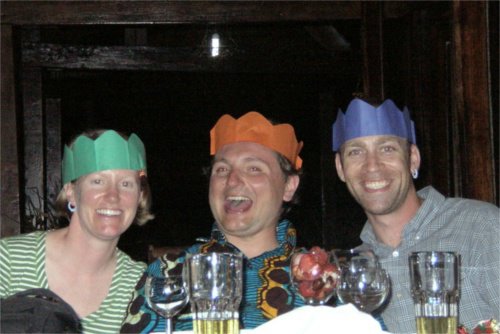
I last wrote about leaving Diffa, something I managed to successfully do—even after looking at (and, gasp, filming) the horse. My last month in Niger was a blur of activity, right up until the moment of boarding the plane to Paris. I scored a side-contract with the Peace Corps to facilitate a close of service conference for a group of volunteers at Park W. The sessions went well and were fun, and the volunteers seemed to really appreciate my experiences and perspective. I didn’t tell them that if they end up being like me that 8 years from now they’ll be hard-pressed to remember anything they heard during the conference. The safaris failed to produce sightings of any sexy mega-fauna; in November animals can still find plenty of water off the beaten paths. We partied hard with some Gourmanché dancers, who after getting hepped up on the local millet-beer brew-choukou-shook their groove-thang until midnight. The dancers weren’t the only ones to partake of an adult beverage: Here’s a shot of me and some drunken hotel staff.


Everybody's feeling just fine!

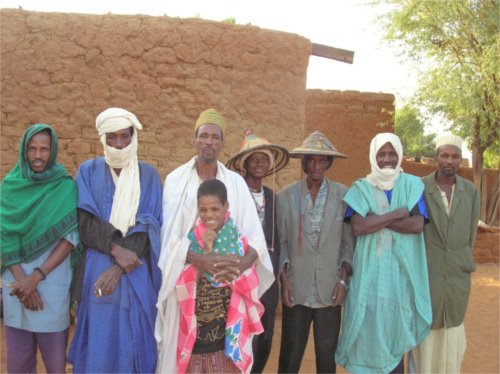
After the conference, I put back on my CARE hat and headed back out into the field for one last campaign. This time I was going back to my old stomping grounds, Konni, (west side, ah-yeah!) to visit a village where a CARE project is working to help prevent moderately malnourished kids from becoming severely malnourished. The visit was positive and I think I’ll post my human-interest story later that describes what I saw. Thankfully, I had enough time in Konni to travel out to Kristen’s old Peace Corps village and greet the folks there. And, by some fluke of topography and technology, there is one spot on the outskirts of town by a big Neem tree where you can get cell coverage. So one night, with a small group of Kristen’s old buddies, we placed a call to Madagascar, and visited with Kristen. Once back in Niamey, there was no shortage of things to do, which kept me busy right up until the end.

Also on the plane with me were other foreigners who were returning to the west after having helped with the crisis in some way. Unintentionally eavesdropping on conversations, I listened as some tried to process the experience of being in Niger and of living and working with Nigeriens. They struggled to articulate their feelings about how their experience had done more to change them than to impart any lasting influence on the Nigerien population. I smiled inwardly, as I listened to a familiar debate and mused over the power that Niger seems to hold over its visitors.

I returned to Madagascar almost exactly three months after having left. And, after a month-long period over the holidays traveling about, I’m back where I started. At first it was difficult going from a charged environment, full of pressure and deadlines to one without, but I’m back in the swing of things and the cadence, in absence of anything else, suits me fine.

I’m trying to implement a New Year’s resolution to be a better blogger, although with one month already burned in 2006, things aren’t looking so good...

Thanks to all who made frequent visits to the blog and who sent words of encouragement. It meant a lot. Stay tuned for more posts.

Saturday, November 05, 2005

Taxi rides in Tana

Another guest post from KP

Taxi rides in Tana are, more often than not, an adventure. Tana (the thankfully shortened moniker for Antananarivo – “The City of a Thousand”, Madagascar’s capital) is a hilly city. Think: San Francisco, without bay views (or earthquakes). After their conquest of the city in 1895, the French invested no small amount of money in the capital in their effort to turn it into a city akin to what one might find in southern France. I’m not sure that they were successful. Furthermore, I doubt that the cobblestone streets in the Old Town have been replaced since 1895, which contribute to the reckless abandon with which taxi drivers hasten to navigate their 1960 era Peugots (full of holes themselves) around the gaps of missing cobblestones and bumps of upended cobblestones. Descending from the Old Town, the streets become paved, enabling the taxis to augment their speed, but the passages remain narrow and curvy, causing passengers to reach for oh shit handles which don’t exist. As one enters the sprawling ‘suburbs’, the streets become roads more recognizable to those of us who grew up in places with well-run Departments of Transportation: lines separating the lanes, designated turn lanes, and roundabouts labeled with clear signs. Despite this sense of order, taxi drivers don’t feel obliged to remain in their lanes, crossing over into the oncoming traffic lane at will to pass slower vehicles (paying no heed to looming oncoming traffic).

In Fianar, my daily commute to work is a four minute walk. Commutes in Tana are a stark contrast, and when I visit Tana, my morning routine becomes a race against the clock when I suddenly remember at 7:00 that I need to allow at least 30 to 60 minutes for the commute to get to my first meeting. Traffic jams seem worse than those in the US, as catalytic converters and environmental air pollution laws are unknown in Madagascar; numerous vehicles spew trails of dark smoke.

Two weeks ago when I was in Tana, I had an especially fun taxi ride. I had an appointment downtown at 2:30, and as I was staying in the burbs with an expatriate friend, I left the house to walk up to the main road to catch a taxi around 1:30. It was Saturday, so I hoped there wouldn’t be too much traffic. I am at the point in Malagasy where I can hail a taxi and tell the driver where I need to go (and that’s about it). I don’t know what I said, but the taxi man thought that I spoke fluent Malagasy. He proceeded to converse with me throughout the ride. Every few minutes, I’d recognize a smidgen of what he was talking about, enough to throw in an appropriate word, and he kept on chatting. He wasn’t convinced of my lack of language skills, even when I would say things in French and explained that I really don’t speak Malagasy.

One feature of taxi rides in Tana is coasting. It’s an art form, really. As we pulled out, I felt like we were going a little too fast – till I realized it was because we were approaching a hill down which the driver intended to coast at top speed. We picked up enough momentum that we were able to pass another taxi as we barreled down the hill. One disconcerting feature of this taxi was that the driver had to wrench the steering wheel to the left immediately before shifting. We stopped at a gas station along the way, and he grabbed a 1 liter plastic water bottle out of the front seat, and filled it with gas. I assumed he would then fill up some other plastic container under the hood– proper gas tanks aren’t deemed a necessity for taxis around here – instead, he replaced the bottle full of fuel on a shelf under the glove compartment, carefully positioning it so it wouldn’t spill, and we drove the rest of the way with our extra gasoline inside the car.

I tend not to favor unsafe conditions which are out of my control, and more often than not taxi rides in Tana certainly fall into that category. For some reason, though, these taxi rides almost always put me in a pleasant mood. The unexpected moments bring a smile, and make up for the long commute.

Wednesday, November 02, 2005

Parting thoughts on Diffa


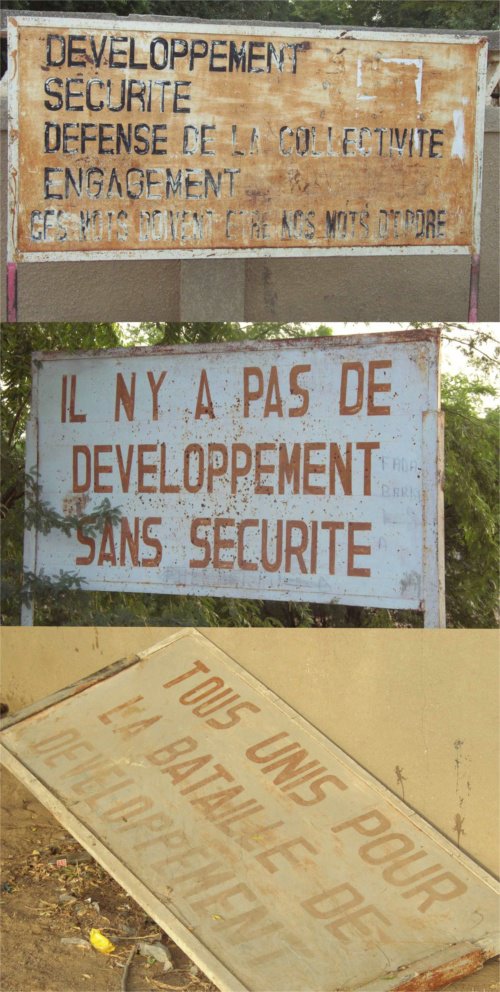
Kountché era slogans

Today I saw a goat wearing a tomato paste can as a shoe. Except for some difficulty traversing the road, he seemed untroubled by his new footwear. Niger never stops delighting my sense of humor.

The big news is that the month of Ramadan officially ended yesterday. Every year brings a huge debate over the starting and ending dates of the month, because some locales claim to see the moon earlier or later than others. Last night there was added tension in Diffa where an unusual cloudy evening obscured all celestial bodies, making the radio and television the go-to source for confirming the month’s end. I woke up this morning at my usual time, asked the guardian if today was the fête, he said yes, so I went back to sleep until 11. I think I’ve had some pent up exhaustion from the past two months and was grateful for the rest. Walking to the office, even at the noon hour, there were gangs of people in the street dressed in new outfits and making merry, clearly very happy that another year of Ramadan has ended.

The houseflies in Diffa have started taking a greater interest in my morning commutes lately. At first I wondered if I had neglected some crucial step in my morning personal hygiene routine. A mental audit, however, came back negative on that front and a quick sniff of the pits confirmed that I didn’t carry the scent of carrion on my person. I’ve concluded that the hitchhiking flies were a harbinger of the approaching cold season. This assessment seemed strengthened by the presence of dust-filled skies, another horseman of the harmmatan. Only the mornings are hazy, the sun still has enough strength to burn through the dust to make daytime temperatures sufficiently hot and miserable. Soon, the wind will suspend enough dust—and black plastic bags—to render the sky a reasonable proxy of a nuclear winter. The lower temperatures will provoke complaints from the average Abdou, and second-hand ski parkas will become this season’s “must have” fashion item. But, by the time this happens I will have left Diffa, and its houseflies, behind.

I feel a bit conflicted about leaving Diffa. I didn’t anticipate spending as much time in this corner of Niger as I have, and it’s been a mixed bag. The hardest part has been dietary. There are few restaurants here, and during Ramadan the only restaurant I had found stopped serving food halfway through the month. I’ve lived off corn flakes, sardines and fried bean cakes for the past three weeks. I only had one cartoon-like moment where a person talking to me stopped being a person and was transformed into a giant talking piece of fruit. All in all, that seems pretty good to me.

What I’ve found is that Diffa seems largely anachronistic. If Mark Twain had lived in Niger, he might have chosen Diffa as the place to live should the world have ended instead of Kentucky. I can imagine that this unchanging characteristic is a source of comfort for some and discomfort for others, particularly the youth. Aside from the presence of cell phones and a zillion motorcycles, I don’t imagine that Diffa has substantially changed in twenty years. It is the only place I’ve been in Niger that still has Kountché-era billboards on display, which are largely propagandistic and military in tone. In essence, they all portray “development” as a fight that can only be won with a secure state and a cooperative (i.e., compliant) populace. What was true then for Diffa, I think, is still true today. Being so remote, Diffa has cultivated a strong sense of independence and is viewed cautiously from Niamey as a place with the potential to incubate political unrest.

Upon entering Diffa from the west, you pass under an archway with a statue of solider on horseback atop the arch. Local lore has it that if you look at the horse as you are leaving town then you will return to Diffa another day. People at the office have been teasing me that each time I leave Diffa I look at the horse and that’s what keeps bringing me back. This time I’m not taking any chances—I’m going to be blindfolded. Maybe I’m not as conflicted as I think.

Tuesday, November 01, 2005

Kristen explains her fellowship

Here's guest post from Kristen about her fellowship in Madagascar


The four stars stand for: Nature, Health, Wealth, and Power


Kristen serves as a population, health, and environment advisor for SantéNet, a USAID funded comprehensive health project, in their Fianarantsoa regional office. Kristen has participated actively in the conceptualization and launch of Kominina Mendrika (Champion Commune), a commune level mobilization and demand creation approach to achieve health, environment, economic development, and good governance goals.

She is charged with contributing to the organizational development of three Malagasy NGOs which are implementing partners for Kominina Mendrika (KM). The NGOs are members of Voahary Salama, a Malagasy association dedicated to integrating health, population, and environment. Kristen collaborated with the Ecoregional Initiatives (ERI) project and the NGOs to develop complementary environment activities (funded by ERI) in six communes where the NGOs are concurrently implementing the health component of KM (funded by SantéNet).

Kristen is coalescing partners for water, sanitation, and hygiene initiatives in the Ranomafana – Andringitra forest corridor. She will also document a history of PHE initiatives in Fianarantsoa from 1990 to the present.